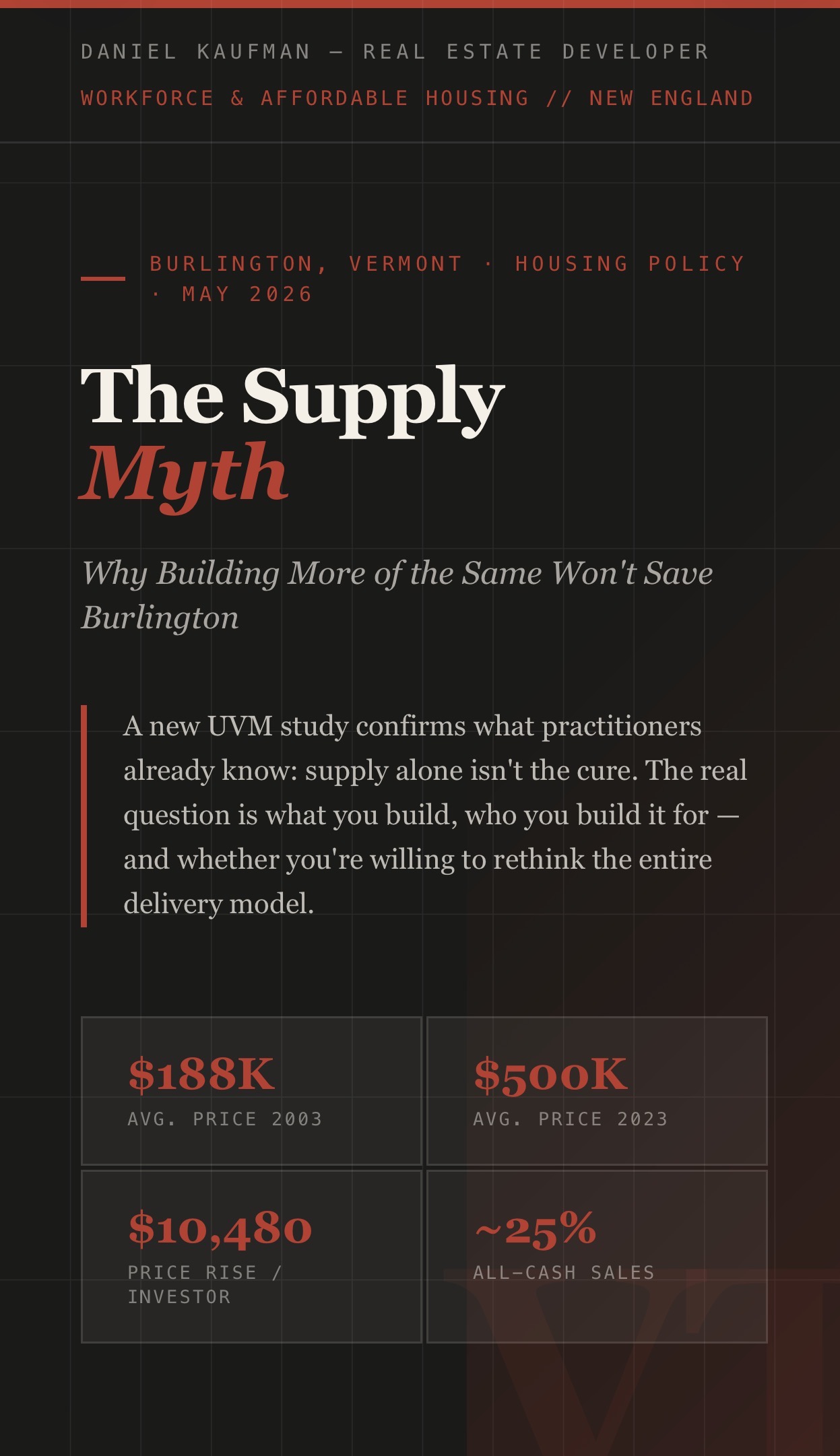
The Supply Myth: Why Building More of the Same Won't Save Burlington
By Daniel Kaufman — May 2026
I've been developing workforce and affordable housing in New England long enough to recognize a zombie idea when I see one. The zombie in question: if you just build more units, prices will fall. It sounds so reasonable. It's Econ 101. Increase supply, reduce price. Works great for soybeans. Doesn't work nearly as cleanly for the thing people sleep in.
A newly published study out of UVM — authored by economist Joe Ament and doctoral student Chris McElroy — just put some real data behind that skepticism, specifically in Burlington. The researchers analyzed more than 4,000 single- and two-family home sales over two decades, from 2003 to 2023, and what they found should reshape the policy conversation across all of New England, not just Vermont.
THE NUMBERS THAT STOP YOU COLD
Burlington's average home price nearly tripled over the study period, climbing from roughly $188,000 in 2003 to almost $500,000 by 2023 — with the steepest acceleration happening in recent years. The culprit, per the researchers, isn't just a shortage of units. It's who's buying, and how.
The study tracked investor purchases — primarily LLCs and corporations — watching them rise from just three transactions in 2003 to roughly twelve percent of all sales by 2023. Each additional investor in the market correlated with roughly a $10,480 jump in overall home prices, climbing past $13,000 when larger down payments were factored in. About a third of investor purchases were all-cash. Nearly a quarter of all Burlington home sales in recent years closed with no mortgage at all.
Here's the kicker, and Ament says it plainly: "There's just no evidence that building more housing would bring prices down. It's quite the opposite."
His reasoning is structural. In a high-cash, investor-active market, new supply gets absorbed quickly — often at the top end of the market — and doesn't filter down to the households who actually need relief. The researcher's own math is striking: removing a single investor from the market would have roughly the same affordability effect as adding eight homes. Think about what that means for every dollar spent on new construction versus demand-side policy.
"The supposedly simple supply-and-demand model is not simple. There are assumptions built in that don't hold for housing. And there are power dynamics that need to be accounted for." — Joe Ament, UVM Economist
I'M A DEVELOPER. I'M SAYING THIS.
Let me be clear about what I'm not saying. I am not anti-development. I am not anti-supply. I am actively developing and building workforce and affordable housing units right now in Burlington and across New England. I believe in building. But I've spent enough time in pro formas and entitlement hearings and capital stacks to know that the "just build more" crowd is usually talking about building the same thing we've always built — market-rate, luxury-leaning, expensive-to-deliver product — and expecting different outcomes.
That's not a solution. That's a press release.
Ament frames the core question exactly right: "If we're going to make more, we need to be asking: What kind? And who will own it?" As someone who spends their days wrestling with those exact questions on active projects, I can tell you that most of the housing conversation — at the policy level, at the municipal level, in the press — skips right over them. The debate is almost always about quantity. Rarely about type. Almost never about ownership and operation model.
THE MARKET ISN'T BROKEN. IT'S WORKING EXACTLY AS DESIGNED.
One of the study's more uncomfortable findings is about down payments. Non-investor buyers in Burlington have more than doubled their down payments over the past two decades. The majority now put down more than 20 percent — a pattern that used to be an investor hallmark. In other words, regular buyers are being forced to act like investors just to compete. The cash arms race is spreading.
This isn't a market failure. This is a market doing exactly what markets do — allocating to the highest bidder, concentrating wealth, and optimizing for return on capital. If you believe that's fine, great. But if you believe that teachers, nurses, first responders, and service workers should be able to afford to live in the communities they serve, then you have to be willing to say the quiet part out loud: the market, left alone, will not solve this. Not in Burlington. Not in Portland. Not in Newry or Rumford or Waterville.
That's not a political statement. It's an observation from someone who reads the closing documents.
SO WHAT DOES ACTUALLY MOVE THE NEEDLE?
The study gestures at demand-side policy — curbing investor activity, creating waiting periods, targeting institutional buyers. Vermont's legislative attempt along those lines, introduced by Rep. Emilie Krasnow, would have required certain investors to wait 90 days before purchasing single- and two-family homes. It didn't advance. No surprise there — these measures are politically difficult and tend to be watered down or killed before they reach anyone with real purchasing power.
I don't think policy alone gets us there either. What I've come to believe — after years on the ground in New England markets and beyond — is that the delivery model itself has to change. The way we finance, design, build, and operate workforce housing is broken at the process level. We keep running the same play and wondering why the score doesn't change.
OLDIVAI IS ASKING THE RIGHT QUESTIONS
One organization I've been watching closely that's actually rethinking the delivery model — not just the financing — is Oldivai (www.oldivai.com). Their thesis is elegant and, frankly, overdue: workforce housing starts with employers, not just developers or municipalities.
Oldivai partners with large employers — health systems, school districts, major institutional employers — to identify underutilized land in their own real estate portfolios and deploy it for workforce housing. Their Oldivai Index runs proprietary market analytics to assess affordability gaps and match solutions to specific labor markets. On the construction side, they've built a standardized, modular, Lean/Six Sigma-driven production process — tested on a 10-unit pilot project in Spokane — that's designed to scale nationally without reinventing the wheel on every project.
The insight that jumps out at me: they're targeting the "missing middle" — households earning 80–120% of AMI — which is exactly the segment that conventional affordable housing tax credit programs don't serve well and market-rate development has zero incentive to build. Teachers. Nurses. First responders. The people Ament's study is talking about when it describes buyers forced to compete with all-cash investors.
I'm not saying Oldivai has solved the problem. Nobody has. But they're asking the right questions: What kind? And who will own it? — which puts them ahead of most of the conversation happening at the policy level right now. That's the conversation Burlington needs to be having. That's the conversation all of New England needs to be having.
WHAT THIS MEANS FOR BURLINGTON — AND EVERY MARKET LIKE IT
Burlington is a canary. It's a small, high-demand market with a strong university anchor, a tight geographic footprint, and a civic culture that genuinely wants to solve this. If the supply-only playbook doesn't work here — and the UVM data suggests it won't — it's not going to work in the dozens of similar New England cities and towns where we're seeing the same cash-buyer dynamics, the same investor activity, the same squeeze on workforce households.
What works is what's hard: targeted workforce housing programs tied to employer demand, modular and factory-built construction that drives down per-unit cost, ownership and operation structures that keep units affordable over time rather than flipping back to market rate in fifteen years, and policy that's willing to actually look at demand-side dynamics rather than just counting permits.
We have to build. We have to build more. But we have to build smarter, for different people, with different capital, in a fundamentally different way than we've been doing it. Building more of the status quo will deliver more of the status quo.
Burlington — and every market that looks like Burlington — deserves better than that.
ABOUT THIS BLOG
This blog is where I think out loud.
I've spent more than two decades developing workforce and affordable housing — in Maine, across New England, and in markets from Vermont to Nevada. I've read thousands of pro formas, sat through hundreds of entitlement hearings, navigated capital stacks that would make your head spin, and watched the same policy debates play out in city after city with the same inconclusive results.
This blog is my attempt to say plainly what practitioners know but rarely say publicly.
I write about housing policy, development economics, and the real mechanics of getting workforce and affordable housing built — not the press release version, but the ground-level version. I write about what's working, what isn't, and why the conventional wisdom so often leads us in circles.
I write from active projects. Right now I'm developing in Burlington, Vermont, Bethel, Waterville, Rumford, and across coastal and western Maine. I'm building modular, I'm building infill, I'm building in markets that the institutional capital world has largely written off. Every post is informed by something I'm actually working through on a real deal.
The format is practitioner's voice, not academic. Data-forward where the data is good. Skeptical of received wisdom. Willing to say the quiet part out loud.
If you're a developer, an investor, a planner, a policymaker, or just someone trying to understand why housing costs so much and why it seems so hard to fix — this blog is for you.
ABOUT DANIEL KAUFMAN
Daniel Kaufman is a real estate developer, investor, and founder of Kaufman & Company, a development and investment firm focused on workforce and affordable housing across New England and select national markets.
With more than 25 years of experience in real estate development, construction, and impact investing, Daniel has led the investment of seven equity funds, resulting in over $2 billion in property investments and the financing and development of more than 10,000 housing units. He is an active member of the Urban Land Institute Affordable Workforce Housing Council, the National Multi Housing Council, the Pension Real Estate Association, and the Aspen Institute First Movers Fellowship.
Daniel is the co-founder and President of Oldivai, a vertically integrated workforce housing development platform that partners with large employers — health systems, school districts, and institutional employers — to identify underutilized land and deliver modular, scalable workforce housing for the "missing middle." Oldivai's standardized, Lean/Six Sigma-driven process is designed to transform how workforce housing gets built and financed nationally.
He is also co-founder of Convivium Living, a bridge lending platform focused on workforce and affordable housing transactions across New England and beyond.
Daniel is based in Maine, in the western mountains near Sunday River, where he is an avid skier and season pass holder with strong opinions about how ski resorts should be run. His active development pipeline spans Burlington, Vermont; Bethel, Waterville, Rumford, and Portland, Maine; and other markets across New England.
He writes at danielkaufmanrealestatedeveloper.blogspot.com and can be found on social media at @danielkdevelops.
Professional website: danielkaufman.info
Source: Tracy Brannstrom, "Study Says Building More Homes in Burlington Won't Lower Costs," Seven Days, April 28, 2026 — reporting on "It's Not About Supply," Ament & McElroy, SSRN, 2026. Full study: papers.ssrn.com/sol3/papers.cfm?abstract_id=6103847


Comments
Post a Comment