THE FRESHWATER FRONTIER: WHY MICHIGAN IS THE MOST UNDERRATED DEVELOPMENT MARKET IN AMERICA
By Daniel Kaufman | May 2026
People ask me constantly where I see the next wave of real estate opportunity. They expect me to say Texas. Maybe Florida again. Sometimes they’re hoping I’ll say something contrarian like Cleveland or Gary, Indiana, so they can nod and feel sophisticated.
I’m going to say Michigan.
Not the Michigan of the rust belt narrative. Not “Detroit comeback story #47.” I’m talking about three specific markets that most coastal developers haven’t touched — and that’s exactly the point. The Upper Peninsula. Traverse City. Grand Rapids. Three completely different stories with one connecting thread: fresh water.
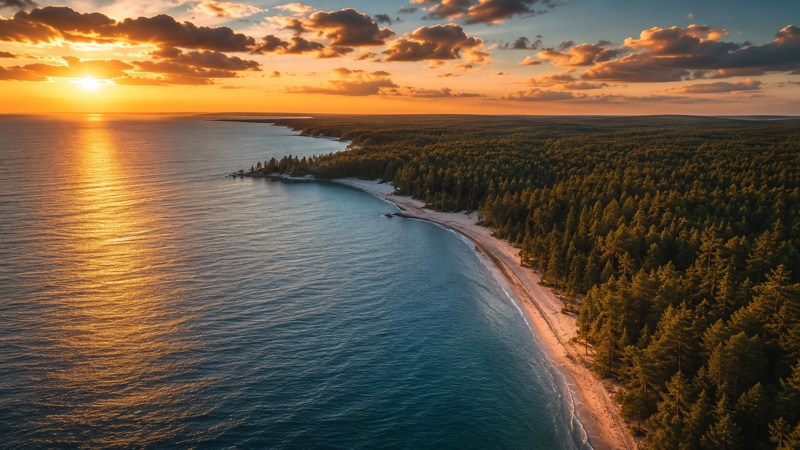
You want to talk about the most undervalued long-term infrastructure asset in the world? It’s not data centers. It’s not lithium. It’s clean, abundant, accessible freshwater. And Michigan sits on top of more of it than almost anywhere on earth.
Let me break this down market by market.
THE UPPER PENINSULA: AMERICA’S LAST FRONTIER DISCOUNT
Here’s a number that should get your attention: raw land in Michigan’s Upper Peninsula trades at roughly $1,000 per acre for remote acreage. A thousand dollars. One acre. In a region that borders Lake Superior, Lake Michigan, and Lake Huron — three of the five Great Lakes.
That’s not a typo. That’s a market inefficiency.
The U.P. has historically been dismissed as too remote, too cold, too far from everything. And for a long time, that analysis was correct. But the remote work revolution didn’t just shuffle people from San Francisco to Austin. It reshuffled the entire premise of where people choose to live. When your office is a laptop and a good internet connection, “too far from everything” stops being a liability and starts being the whole point.
Escanaba is projecting 4.8% housing price growth through mid-2026 — the highest rate in the state. Marquette is right behind at 4.2%. These aren’t accident numbers. These are what happens when a constrained supply base meets a new class of buyers who are actively choosing quality of life over proximity to a commute they no longer make.
The state of Michigan got there too. Governor Whitmer’s office has been pushing housing development funding into the U.P. — a mixed-use project in Chassell just broke ground with 22 new residential units in a downtown that hadn’t seen new construction in a generation. That’s not a blip. That’s the government acknowledging what the market is already telling anyone willing to read the data.
For a developer willing to do the work — and the work is real, entitlements in rural markets are their own adventure — the U.P. represents the kind of land basis that makes deals pencil at attainable price points. You’re not fighting $15,000-per-acre suburban Detroit comps. You’re operating in a region where infrastructure improvements reprice land quickly and dramatically, and where you’re still early enough to set those comps yourself.
The climate framing matters here too. The Upper Peninsula is cold. That’s been the marketing problem for 150 years. But watch what happens as the Sun Belt’s heat, drought, and wildfire risk continue to accelerate. “Cold” reframes as “temperate.” “Remote” reframes as “resilient.” Lake Superior doesn’t dry up. The groundwater doesn’t deplete. When Phoenix is rationing and parts of California are literally on fire, the Upper Peninsula’s greatest liabilities become its greatest assets.
TRAVERSE CITY: WHERE THE NUMBERS DON’T LIE
I want to introduce you to Lawrence Yun, the chief economist for the National Association of Realtors. In January 2026, he stood in front of a room full of Northern Michigan real estate professionals and told them something direct: “Even though nationwide there was a 0% change in home sales, locally, you had a 7% increase in net sales.” Then he said: “Michigan is in a tough spot, but you are in a better spot.”
When NAR’s chief economist tells a local market they’re outperforming the country, you write that down.
Traverse City and the surrounding Grand Traverse County have been posting numbers that are frankly embarrassing compared to the national average. Williamsburg, just east of TC, posted 22.28% year-over-year price growth. Leelanau County surged 10%, pushing its median to $715,000. The overall Grand Traverse County market saw gains as high as 14.53% year-over-year — in an environment where the national expectation was 3 to 4%.
Total residential sales volume in Grand Traverse County hit $749 million in 2025 — a 7.46% increase from the year before, even as average prices softened slightly. That’s not a weakening market. That’s a market with more transactions at more accessible price points, which is exactly the volume signal that precedes the next run.
Here’s the structural reality: a 2023 housing needs assessment identified a need for more than 1,010 additional rental units in Traverse City alone. The city’s population is growing while the state of Michigan overall is declining. The area is not producing housing supply to meet the need — especially not at price points that serve year-round, working-class residents. That gap isn’t closing on its own.
Traverse City has two economies running simultaneously. There’s the seasonal tourism economy — over 6,100 active short-term rental listings in the north coast market, occupancy hitting 72% at peak season — and there’s a growing year-round economy built on hybrid-work migration, healthcare, food and beverage (this is cherry country and wine country), and outdoor recreation infrastructure. The second economy is the development opportunity. Because tourism dollars fund the amenities, but workforce housing is what makes the year-round economy function.
Cherry orchards. Lake Michigan. The Sleeping Bear Dunes. The Old Mission Peninsula wine trail. Traverse City has the kind of lifestyle infrastructure that used to require a trust fund to access. Remote work democratized that. Now you need a developer willing to build attainable housing to serve the people who actually run the place.
That developer could be you.
GRAND RAPIDS: THE MIDWEST’S MOST UNDERVALUED URBAN MARKET
Grand Rapids doesn’t get the press it deserves. It’s not as photogenic as Traverse City. It doesn’t have the frontier mystique of the U.P. It’s a mid-size Midwestern city with good bones and an economy that has quietly become one of the most resilient in the country.
The data from the Grand Rapids Chamber’s 2025 State of the Region report is worth reading slowly:
Private business growth of 33.3% from 2013 to 2023 — the highest rate among major Midwest metros.
Housing prices up 251% over that period.
Leads the Midwest in population growth at 8% over the past decade.
Household income at $80,296 — highest growth in the region.
Construction wages up 46.7%.
The Right Place, Grand Rapids’ economic development organization, delivered its 2026 outlook to a room full of local business leaders and the message was unambiguous: the area is performing better than comparable metros because it diversified its economy away from any single industry. It’s a lot more than just furniture now — healthcare, life sciences, clean energy manufacturing, battery technology, higher education, and a food and beverage sector that punches above its weight.
Grand Rapids has a cost of living 5.5% below the national average. The typical home value is $268,540 in 2026. Forecasts project 3.2% appreciation through 2026 in West Michigan — steady, not spectacular, but built on a foundation of genuine economic diversification rather than speculative heat.
For a developer, that’s the profile you want: a market where demand is structural, not cyclical. Where the jobs that create housing demand come from multiple sectors rather than one employer or one industry. Kent County is projected to need 6,300 additional households by 2030, and even with 6,000 units added from 2022 to 2024, supply still trails demand. The millennial buyer cohort — the largest homebuying generation in history — is active and engaged in this market. They’re not moving to Grand Rapids for the amenities. They’re moving there because they can afford to build a life.
That’s the opportunity.
THE THREAD THAT TIES ALL THREE TOGETHER: WATER
I want to come back to water because I think most real estate investors are still underpricing what freshwater scarcity means for long-term asset values.
The Great Lakes contain 21% of the world’s surface fresh water. Michigan borders four of the five Great Lakes. It has more freshwater coastline than any other state. While the American Southwest negotiates over Colorado River allocations and the Southeast watches aquifers deplete, Michigan sits on a resource that is genuinely irreplaceable.
Climate-driven migration is already happening. Phoenix posted its hottest summer on record. Parts of Florida are watching homeowners’ insurance evaporate before the properties do. The Sun Belt narrative that drove two decades of population growth is starting to crack around the edges. Not everywhere and not all at once — but the trajectory is visible.
The people who will move toward freshwater, toward temperate climates, toward four seasons and sustainable water supply — they need somewhere to live. They need workforce housing in Traverse City. They need attainable apartments in Grand Rapids. They need someone to take the U.P. seriously before land prices reprice and the window closes.
Michigan isn’t the past. It’s not a rust belt comeback story or a nostalgia play. It’s a market that sat undervalued while everyone chased sunshine — and that undervaluation is correcting in real time.
The question isn’t whether Michigan represents opportunity. The data is clear on that.
The question is whether you’re going to be early or late.
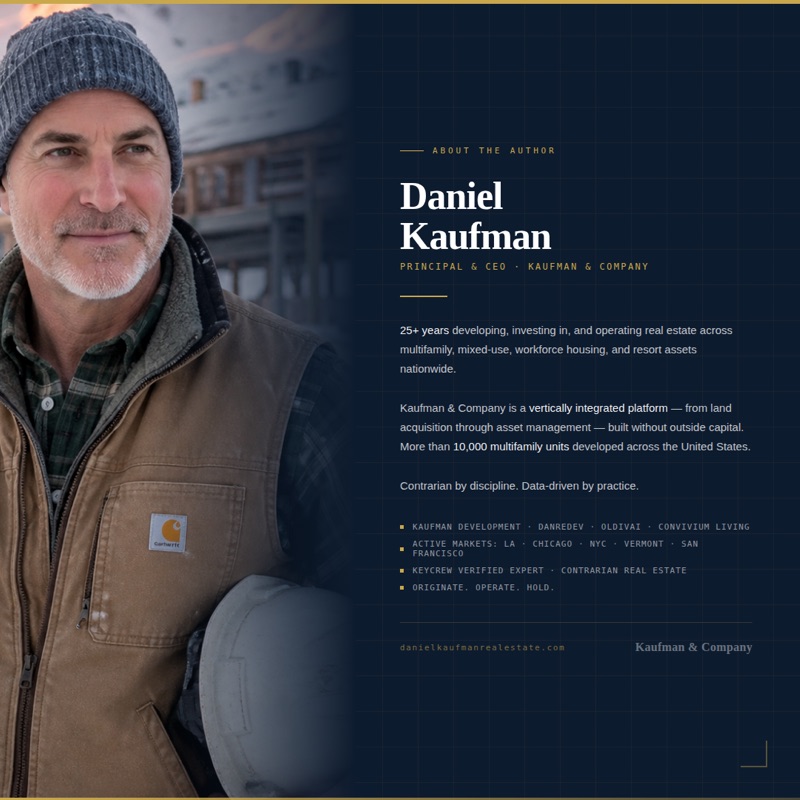
Daniel Kaufman is a real estate developer and investor. He is the founder of Kaufman & Company and co-founder of Convivium Living. Follow him at @danielkdevelops and at: http://www.danielkaufman.info


Comments
Post a Comment