Navigating the Pivot: What the Supreme Court’s Tariff Ruling Means for Real Estate Development
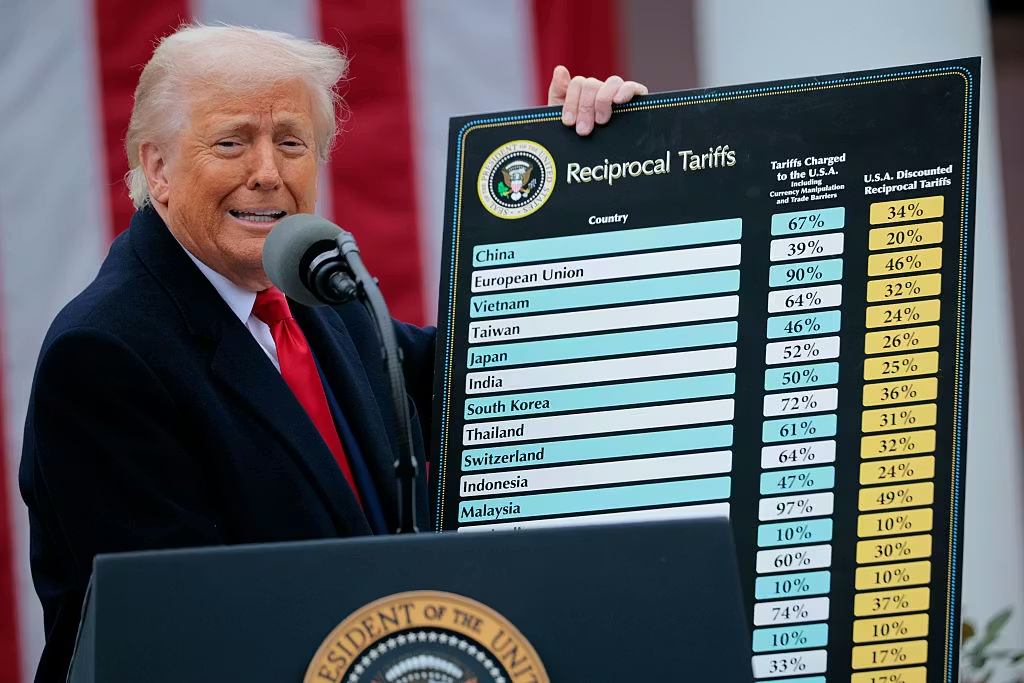
In the world of real estate development, we often talk about "pivoting"—adjusting a project’s scope or financing when the market shifts. This past week, we saw a macro-level pivot of historic proportions.
On February 20, 2026, the Supreme Court delivered a landmark 6-3 decision striking down the administration's "reciprocal tariffs" that were originally imposed under the International Emergency Economic Powers Act (IEEPA). For those of us tracking construction costs and material lead times, the news was a momentary breath of fresh air—immediately followed by a new set of variables.
The Court’s Decision and the Immediate Response
The Supreme Court ruled that the executive branch overstepped its authority by using the IEEPA to impose the "Liberation Day" tariffs. This involves roughly $170 billion in revenue collected through February 20. While Justice Brett Kavanaugh noted in his dissent that the refund process for these billions is likely to be a "mess," the ruling technically removes a significant burden from the global supply chain.
However, the administration’s response was nearly instantaneous. By Saturday, February 21, the 10% global tariff initially announced under Section 122 of the 1974 Trade Act was increased to 15%.
The "Hard" Costs: Timber, HVAC, and Beyond
For developers, the "legal mechanism" matters less than the "bottom line." While the reciprocal tariffs are gone, they are being replaced by a layered system that targets our most essential inputs. Here is the current outlook for specific materials:
Softwood Lumber & Timber: Before the court’s ruling, duties on Canadian lumber had already ballooned to roughly 45% due to separate Section 232 actions. Even if some reciprocal relief occurs, the new 15% global baseline means timber remains a high-volatility line item.
HVAC & Mechanical Systems: This is a primary "pain point." Modern HVAC units are a cocktail of tariffed materials: steel (50% duty), aluminum (50% duty), and copper. Industry analysts suggest that between these metals and the new global surcharge, HVAC equipment costs could see a 10% to 15% increase in 2026.
The "Refund" Factor: There is now a looming battle over refunds for tariffs already paid. For contractors and suppliers who ate those costs over the last year, a refund could provide a much-needed liquidity injection, though the timeline remains unclear.
The Takeaway
As macro strategist Samuel Rines noted, the court’s decision doesn’t necessarily change the "overall tariff picture" so much as it changes the tools. We are moving from a regime of country-specific "reciprocal" taxes to a broader global surcharge that the Yale Budget Lab estimates could keep the average effective tariff rate as high as 13.7%.
In real estate, we build on solid foundations, but we have to be comfortable with shifting winds. My team and I are closely watching how these "Section 122" levies affect the price of finishings and structural components. Whether the effective rate eventually goes down or the administration finds "great alternatives" to raise revenue, the priority remains the same: delivering quality, community-centric developments while navigating a complex global economy.


Comments
Post a Comment