Beyond the Peaks: Strategic Real Estate Investment in North America’s Ski Markets
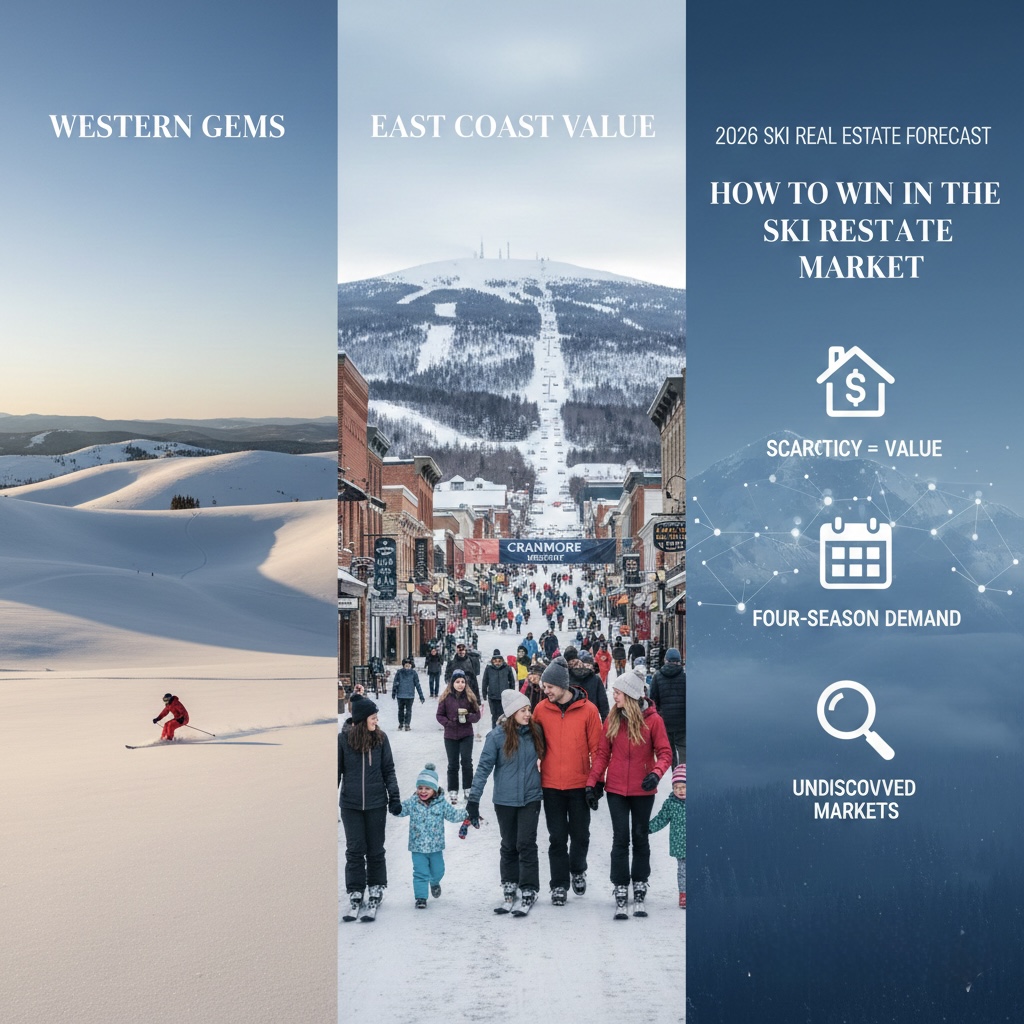
The allure of mountain living attracts significant capital every season, yet a persistent gap remains between developer promises and market reality. For the discerning investor, winning in the ski real estate market isn’t just about buying a view; it’s about understanding the scarcity of convenience.
When a property is slope-side, you aren't just buying square footage—you are buying time. You trade commutes and parking hassles for easier mid-day breaks and spur-of-the-moment sessions on the snow. This inherent utility is why ski-in/ski-out condos and resort residences tend to hold their value even when broader markets cool.
As we look toward 2026, the strategy for "undiscovered" value focuses on three pillars: legitimate terrain, expanding base-area infrastructure, and a diverse inventory mix.
The Western Frontier: Utah, Idaho, and Beyond
The American West remains the heavyweight champion of ski investment, driven by massive vertical and public land constraints that limit new supply.
1. Utah: The Low-Density & Luxury Split
Utah offers a fascinating contrast between high-octane luxury and quiet, private retreats.
Powder Mountain (Eden): A "low-density" pioneer. With a median price of $2.59M, the focus here is on limited-growth private communities like Powder Haven. It’s for the investor betting on exclusivity and uncrowded slopes.
Park City & Deer Valley: These remain the global demand magnets. While Park City offers a broader entry point ($1.1M median), Deer Valley’s massive East Village expansion is the project to watch for modern, luxury-branded residences.
The Value Plays: For those looking for entry-level appreciation, Brian Head ($285K) and Eagle Point ($289K) offer high-elevation skiing at a fraction of the Wasatch Front's price.
2. Idaho: The Four-Season Sleepers
Idaho is transitioning from "locals' secret" to a legitimate investment destination.
Sun Valley: The legacy-luxury play. With a $2.14M median price, it caters to high-net-worth individuals seeking a polished, year-round culture.
Tamarack Resort: A prime example of a purpose-built four-season ecosystem. With a $449K median, it offers a balanced entry for those prioritizing rental performance across both winter turns and summer golf.
The East Coast: High Yields and Hidden History
In the East, the investment narrative shifts toward rental yield and proximity to major metro hubs like Boston and NYC.
| Market | Highlight | Median/Entry Price |
| Stowe, VT | The "Ski Capital of the East" | High-End / Premium |
| Newry, ME | Sunday River access; high ROI | 12.3% Cap Rate |
| Rutland, VT | The "Killington Buffer"—half the price of the base | $255,000 |
| North Conway, NH | Voted #1 Ski Town; massive year-round draw | $372,450 (Lincoln/North Conway) |
North Conway serves as a case study for the "Lifestyle Asset." Its value isn't just in the snow; it’s in the fall foliage, the summer hiking, and the tax-free shopping. When a town has four-season utility, it creates a safety net for investors, ensuring the property isn't sitting empty for six months of the year.
The "Under-the-Radar" Gems
If you are looking for a "pure value" play where the home price hasn't yet caught up to the recreation quality, consider these outliers:
Anaconda, MT: 2.5 hours from Bozeman but with homes near $300,000.
Hurley, WI: The affordability champion with a median price of $114,700 and access to three resorts.
Ellicottville, NY: A tiny town with a big "walkable village" feel and a median price of $274,900.
Key Takeaways for the 2026 Investor
Scarcity is the Superpower: Most ski towns are hemmed in by National Forest land or strict zoning. You aren't just buying a house; you're buying one of the few permitted structures in a high-demand zone.
The "Work from Mountain" Shift: Demand is now driven by tech and finance professionals (mid-40s to 60s) who prioritize high-speed fiber as much as high-speed quads.
Domestic Stability: With global uncertainty, U.S. high-net-worth individuals are parking capital in domestic "lifestyle" assets. 99% of buyers in markets like Vail are domestic, providing a stable floor for the market.
Investing in a ski town is often an emotional decision—a place for family traditions—but the fundamentals of limited supply and multi-season demand are what make it a sound financial one.


Comments
Post a Comment