Fix It in ’26
Happy New Year’s Eve.

Next week I’ll share some predictions for 2026, but before we rush ahead, it feels worth pausing for a moment and looking back at the year we’re closing out.
2025 was… a year.
On a personal level, I’m grateful. Everyone in my life stayed healthy. Business was strong. We made real progress on our workforce housing efforts, which continues to be some of the most meaningful work I’ve ever been part of. For me, it was a very good year.
But if I’m being honest, the broader mood out there felt heavy. The headlines were unsettling. A lot of people seemed on edge. Between political tension, economic anxiety, and the rapid rise of AI, it often felt like nobody quite knew what the future was going to look like. The vibes, as the kids say, were bad.
I asked a simple question on social media recently: How was 2025 for you?
About 30% said “okay.” Another 30% said “poor,” “bad,” or “terrible.” That felt about right.
So how do we even measure how things are going anymore?
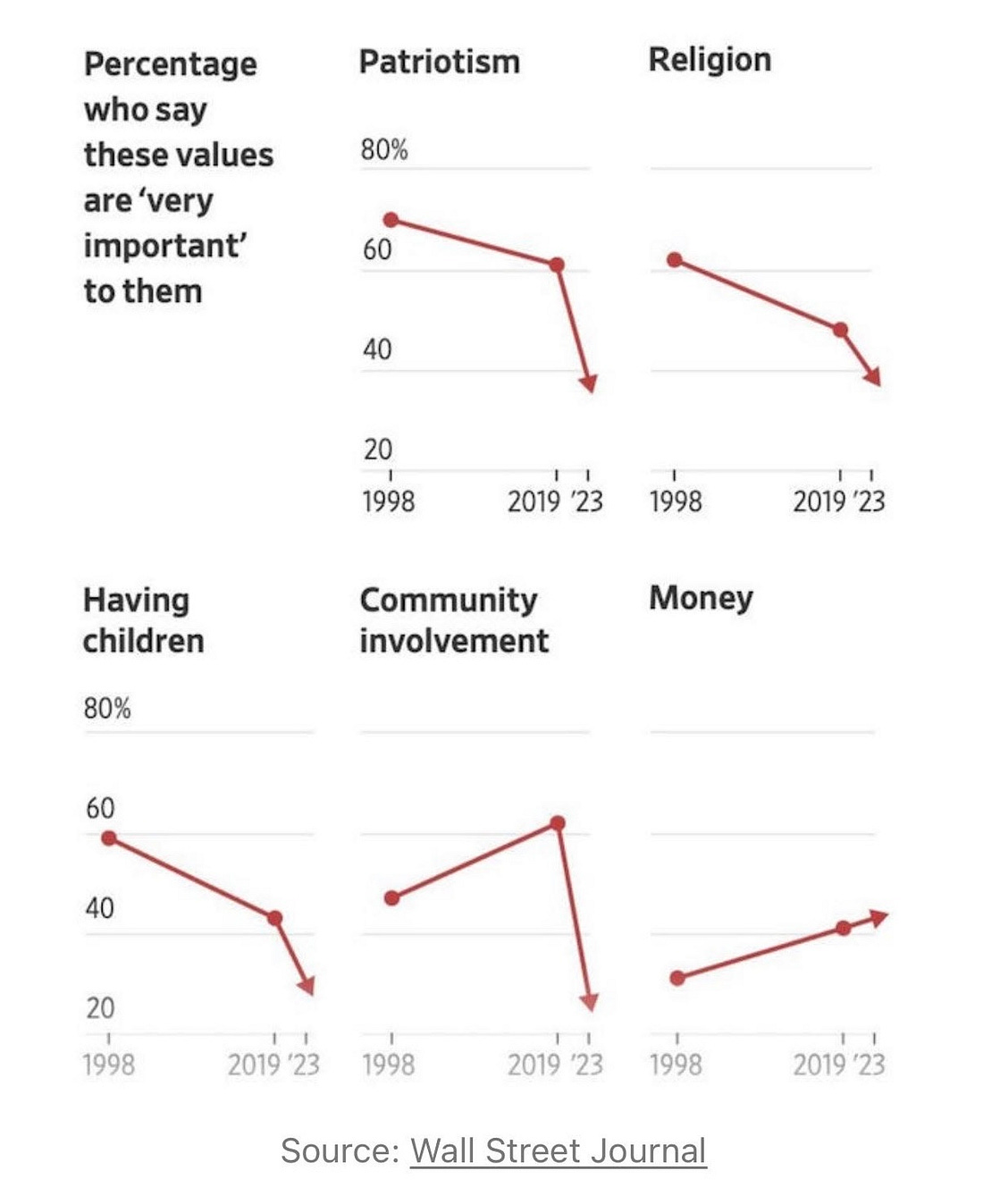
I came across a recent Wall Street Journal poll that asked Americans what they consider “very important” in their lives. The results stopped me in my tracks. Interest in things like patriotism, religion, having children, and community involvement has dropped noticeably. The one thing that’s gone up?
Money.
Yikes. But also… not shocking.
When people feel uncertain—about their future, their safety, their place in the world—it makes sense that money starts to feel like the ultimate measuring stick. Scarcity changes how we think. If you feel like you don’t have enough, it’s easy to believe that everything would be better if you just had more.
And look, I get that. I’ve long believed that one of the most effective ways to improve people’s lives at scale is simply to put more money in their hands. When someone asks, “How was your year?” most of us instinctively think about our finances. Doing better than last year? Probably a good year. Struggling to make ends meet? Probably a tough one.
Still, I’ve never believed the bottom line tells the whole story.
I made plenty of financially unwise decisions when I was younger. I cared more about trying to be a good person—whatever that meant at the time—and doing work that felt interesting and impactful. And over the years, I’ve become more convinced that one of the best things you can do for someone isn’t giving them money at all. It’s helping them find a role, a path, or an opportunity that brings out the best in them and allows them to grow. That kind of alignment is magic.
Social media has complicated all of this. For a lot of people—especially younger ones—it’s introduced a whole new currency: attention. Likes, follows, validation. If you’re a teenager today, what’s the most affirming thing you can receive? A post that blows up. Enough of that, and maybe it turns into money too. An entire industry has grown around this idea, shaping the aspirations of millions.
I’m grateful I came to social media later in life. I grew up in the 70s, 80s, and 90s—before everything went digital—so my brain was fully formed before likes became a scoreboard.
Recently, happiness scholar Arthur Brooks shared something with me that stuck. When he talks about meaning and happiness, financial advice isn’t even on the list. Instead, he talks about having something sacred in your life and choosing the right goals.
As he puts it:
“The problem is that striving for happiness directly, in the abstract, is not possible. Instead you must choose proxy goals—metaphorical stars in the sky—that lead you toward the greater well-being you desire.”
So what are good goals? He offers a few simple but powerful ideas:
1 Focus on people, not things.
If there’s a three-word summary of happiness research, it’s this: happiness is love.
2 Look inward, not sideways.
Happiness has a negative correlation with social comparison. The more you measure yourself against others, the worse you feel.
3 Enjoy the journey.
Arriving at a destination rarely keeps you happy for long. The process matters.
And he adds a fourth that feels especially relevant right now:
4 Stay flexible.
Things change. You’re allowed to change too.
That advice feels far more satisfying—and sustainable—than simply “make more money,” even though money can absolutely be part of the equation.
In the end, happiness is other people. In real life. Showing up. Doing things that matter to them and to you.
Let’s do more of that in the New Year.
Happy New Year.

Here’s to fixing it in ’26.


Comments
Post a Comment