2025 Year-End Review: The Great Decoupling of the American Housing Market
Date: December 2025
From the Desk of: Daniel Kaufman
As the markets closed the final full week of trading on a high note—with the S&P 500 and Nasdaq buoyed by renewed optimism around the AI trade—the real estate landscape tells a much more complex story.
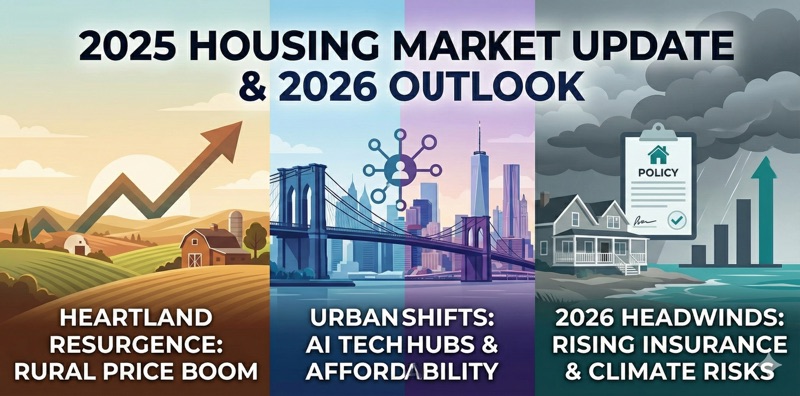
2025 wasn't just another year of fluctuating interest rates; it was the year the market "decoupled." We saw rural equity explode while urban centers stabilized, "accidental luxury" owners get locked into their homes by tax code, and a divergence between the AI-fueled resurgence of San Francisco and the insurance-burdened softening of Florida.
Here is my analysis of the trends that defined 2025 and the headwinds we must navigate in 2026.
1. The Heartland Resurgence: Affordability is the New Luxury
For decades, the investment thesis was simple: follow the jobs to the big metros. But the post-pandemic era has cemented a new reality. The American heartland is no longer just "flyover country"—it is the growth engine of appreciation.
The Data:
Non-metro (Rural) Markets: Saw a median listing price increase exceeding 70% from Nov 2019 to Nov 2025.
Metro Markets: Saw increases just over 30% in the same period.
Migration U-Turn: Pre-pandemic, rural areas lost ~78k residents annually. Between 2021-2023, they gained 540,000.
The Winners:
We aren't seeing this growth in high-end vacation spots (which are cooling), but in "refuge markets"—budget-friendly areas in the Midwest and South.
Blackford County, IN: +186% appreciation (Median price: $156k).
Lauderdale County, TN: +160% appreciation.
Rush County, IN: +158% appreciation.
The Developer’s Take: The primary driver is no longer just remote work; it is strict affordability. As Realtor.com economist Joel Berner noted, this growth is happening in counties with low vacation-home density. The influx of transplants is driving up prices, unfortunately thinning rental options for locals.
2. The "Hidden Tax" of 2026: Climate Risk & Insurance
If 2025 was about high mortgage rates, 2026 will be defined by the skyrocketing cost of "carry"—specifically property taxes and insurance.
The Risk Landscape:
Insurance premiums are projected to jump another 8% in 2026. This is driven by risk density. Approximately $4.3 trillion in reconstruction costs are currently sitting in high-risk zones, a figure expected to rise to $7.2 trillion by 2050.
Top Risk Zones vs. Investor Sentiment:
Despite the risks, people are still buying in high-danger zones, normalizing the threat.
Miami, FL: Highest insurance burden ($22,718/year avg premium).
San Francisco, CA: $274B worth of homes face severe fire risk.
Houston, TX: $92.4B in severe flood risk exposure.
The "Can't Catch a Break" Markets: Cities like Miami are facing a compounding cycle: flood season, hurricane season, then fire season. This is pushing ownership out of reach for many, not due to the mortgage, but due to the monthly escrow.
3. The Inventory Lock-In: The "Accidental Luxury" Problem
A major reason inventory remains stuck is the antiquated capital gains tax code. The exclusion limit ($250k single/$500k married) has been frozen since 1997.
The Consequence:
We now have a class of "Accidental Luxury" homeowners. These are people who bought modest homes decades ago (e.g., my parents in Phoenix, who bought for $64k in '89) and are now sitting on gains that far exceed the tax exclusion.
The Stat: By 2030, 56% of U.S. homeowners may exceed the single-filer exclusion limit.
The Result: A massive "lock-in" effect. Older owners aren't downsizing because they refuse to take the tax hit, starving the market of inventory.
Legislative Watch:
Two proposals are circulating in Washington:
Rep. Greene: Eliminate capital gains on primary residences entirely.
Rep. Panetta: Raise the cap and index it to inflation (a more likely bipartisan path).
Reform here is the single biggest lever that could unlock supply in 2026.
4. A Tale of Two Coasts: San Francisco vs. Florida
As we look toward 2026, two distinct narratives are emerging in major markets.
The San Francisco Rebound (The AI Trade):
Despite the "doom loop" narratives of previous years, SF has surged 36 spots in the "Hottest Markets" ranking.
Driver: The AI revolution is anchoring talent back in the Bay Area.
Metric: Homes are selling in 50 days (faster than the national avg of 64). Buyers are pricing in climate risk as a "line item" rather than a dealbreaker.
The Florida Softening (The Insurance Correction):
Conversely, Florida is facing a correction. We project median sales prices in FL's top metros to fall 1.9% in 2026.
The Condo Crisis: Condo prices are down 10.8% YoY. Special assessments and HOA spikes are crushing this segment.
Outlook: While single-family homes are holding better, the "sunshine tax" (insurance + HOA) is eroding affordability. The Gulf Coast (Cape Coral, North Port) is expected to see the steepest declines (up to 10%).
Summary & 2026 Outlook
The housing market is regaining balance, but it is a fragile balance. The "easy money" era of appreciation in the Sun Belt is pausing, replaced by a search for value in the Midwest and Northeast (Springfield, MA; Wisconsin).
For 2026, keep your eyes on:
Insurance Reform: Will states intervene to cap premiums?
Tax Policy: Will Washington unlock the "accidental luxury" sellers?
The Spread: The gap between "safe" cash-flowing markets in the Heartland and "high-risk/high-reward" coastal markets is widening.
As we move into the new year, the winning strategy remains focused on affordability and mitigating carrying costs.
Happy Holidays, and here is to a prosperous 2026.


Comments
Post a Comment