Posts

9 Things to Watch in Real Estate During Trump’s First 100 Days

Hey friends and family, As you know, I love diving into the details of real estate trends, and with Donald Trump back in the White House, I wanted to share some thoughts on how his early policy decisions might impact the real estate market. These changes could touch everything from construction labor to housing affordability, and while some of this is technical, its also fascinating (at least to me!) how policies shape the market we see every day. Let’s break this down into some key areas that are worth keeping an eye on: 1. Renewed Focus on Opportunity Zones Remember those Opportunity Zones from Trump’s 2017 tax reforms? They encouraged investment in underdeveloped areas with tax incentives. There’s talk of extending and expanding the program beyond 2026, which could mean fresh opportunities for real estate development in these areas. Developers are already gearing up for this potential renewal. 2. Immigration and Construction Labor Trump’s promise of mass deportations could have a bi...

Navigating Inflation, Tariffs, and Policy: What Real Estate Developers and Investors Need to Know

The latest inflation data underscores a mixed economic landscape, where challenges are heightened by policy uncertainty. The U.S. Federal Reserve’s preferred measure of underlying inflation, the core personal consumption expenditures (PCE) price index, rose by 2.8% year-over-year in October and 0.3% month-over-month. While part of this increase reflects the influence of higher stock prices, inflation remains stubbornly above the Fed’s 2% target, raising questions about the central bank’s next moves. Complicating the outlook further is Donald Trump’s economic agenda as he prepares for his return to the political stage. Experts warn that his proposed policies—ranging from tariffs on Canada and Mexico to promises of lower fuel costs—could reignite inflation and reverse post-pandemic economic recovery efforts. For developers, investors, and industry leaders, these dynamics signal potential risks and opportunities to prepare for. Inflation’s Impact on Real Estate While inflation remains a c...

Office Conversions Surge Amid Record Vacancies and Falling Property Values

The commercial real estate market is undergoing a seismic shift as office buildings, once prized assets, face record-high vacancy rates and plummeting values. Developers are responding with an innovative solution: office-to-residential conversions , transforming underutilized spaces into much-needed housing. A Perfect Storm: Office Vacancies and Housing Shortages In Q3 2024, national office vacancy rates hit a record 19.2%, reflecting a shift in work habits and declining demand for office space. At the same time, the U.S. faces a critical housing shortage, with 3.8 million new units needed to meet demand. These dual challenges are driving a surge in office conversions: • 2024 saw 73 completed projects , up from 63 in 2023. • 309 additional conversions are underway , expected to deliver 38,000 residential units, according to CBRE. This creative repurposing of office buildings offers a win-win: addressing housing shortages while breathing new life into struggling urban cores. High-Pro...

15 Housing Markets at Risk: Florida Takes the Spotlight

Image
Parcl Labs recently conducted an in-depth study to identify housing markets with the highest risk of home price corrections. The results are eye-opening, especially for Florida, where 13 out of the 15 markets labeled as "at risk" are located. The Risky Markets: Here are the 15 markets that Parcl Labs has flagged as having the highest correction risk: 1. Crestview-Fort Walton Beach-Destin, FL 2. Daphne-Fairhope-Foley, AL 3. Deltona-Daytona Beach-Ormond Beach, FL 4. Gainesville, FL 5. Homosassa Springs, FL 6. Lakeland-Winter Haven, FL 7. Miami-Fort Lauderdale-Pompano Beach, FL 8. Myrtle Beach-Conway-North Myrtle Beach, SC 9. Naples-Marco Island, FL 10. Ocala, FL 11. Orlando-Kissimmee-Sanford, FL 12. Palm Bay-Melbourne-Titusville, FL 13. Port St. Lucie, FL 14. Sebastian-Vero Beach, FL 15. Tampa-St. Petersburg-Clearwater, FL Why Florida? Florida stands out as the epicenter of this housing market risk. Let's explore why: 1. Hurricane Impact: Hurricane Ian in September 2022 cau...

Florida's Housing Markets Experience Cooling Trends

Image
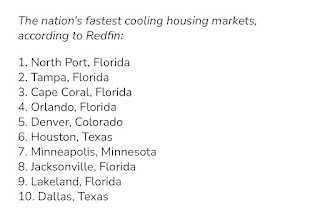
Redfin analysis reveals slowdown in Florida real estate Florida, once a red-hot destination during the pandemic, now faces cooling housing markets. Six of the nation's fastest-cooling markets are in the Sunshine State. Here's what's happening: 1. Increased Supply: Western Florida cities like North Port, Tampa, and Cape Coral have seen inventory surge by over 60% in the past year. Houses take longer to sell, prompting roughly 40% of sellers to reduce asking prices. 2. Natural Disasters Impact: Intensifying storms and rising home insurance costs discourage buyers. Coastal properties face risks due to climate change and sea-level rise. 3. New Construction: Florida is building more homes than any state except Texas. Increased supply helps moderate prices, but elevated mortgage rates challenge sellers. 4. Regional Differences: While Florida cools down, markets in the Northeast remain hot. Rochester, Buffalo (New York), and several New Jersey cities see rising prices and redu...

Multifamily Market Insights: Record Leasing Demand and Investment Trends

Image
Newmark’s Q1 Report: Multifamily Sector Insights Leasing Demand Surges In the first quarter, leasing demand for multifamily units reached impressive levels. A total of 103,826 units were absorbed, marking the largest first-quarter total since 2000. This figure significantly outpaced the long-term average of 38,005 units for the same period. Moreover, the rolling four-quarter demand soared to 317,241 units—the highest since Q2 2022. Southern Markets Lead the Way The South remains a powerhouse for multifamily leasing demand. In Q1, this region accounted for 58.2% of all leasing activity. Notably, the top five markets driving demand included Dallas, Phoenix, Austin (Texas), Atlanta, and Houston. On a trailing 12-month basis, three Texas markets—Houston, Dallas, and Austin—occupied the top four spots. Record-High Deliveries Q1 witnessed an all-time high in multifamily unit deliveries, with 135,652 units completed. Anticipate continued high delivery rates in Q2 and Q3, followed by a deceler...

Retail Sales Decline Again, Strengthening Argument for Rate Cut

Image
Booming Consumer Fades: Retail Sales Data Shows a Spending Slowdown May witnessed yet another lackluster month for consumer spending, as softening economic conditions took their toll on American households. The retail sales report for the month reveals a modest 0.1% increase, following a 0.2% decline in April. However, beneath this seemingly minor shift lie important trends that warrant attention. Key Insights from the Retail Report 1. Mixed Results: Among the 13 tracked categories, five experienced declines. Factors such as cheaper gasoline and Memorial Day discounts at furniture outlets contributed to this mixed performance. The data underscores a broader slowdown in consumer spending—a trend economists attribute to persistent inflation, a cooling job market, and signs of financial stress. 2. A Tale of Two Consumers : Paul Ashworth of Capital Economics points out that slowing services consumption and plummeting consumer confidence suggest households are more affected by higher inter...