A Tale of Two Cities: Why San Diego is Winning the Housing War (And Why LA is Losing)
If you’ve been following the capital markets or trying to pencil a deal in Southern California lately, you already know the vibe shift is real. But the latest numbers paint a picture even starker than most of us realized.
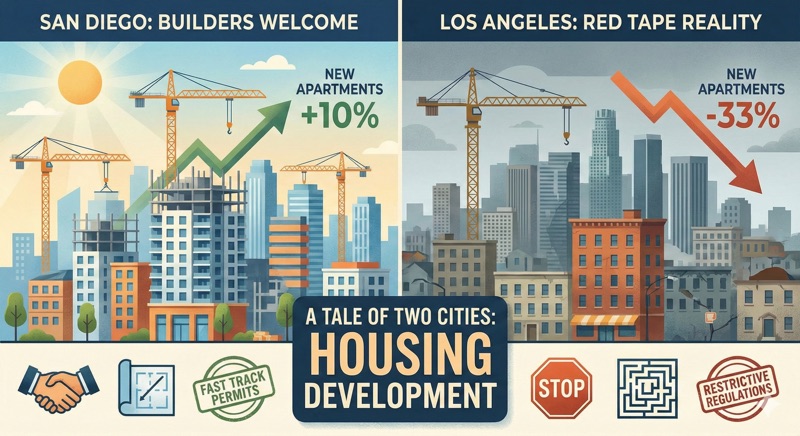
San Diego is currently building apartments at nearly twice the rate of Los Angeles. While construction in L.A. has plummeted 33% over the last three years—hitting an 11-year low—San Diego is up 10%.
As someone who has navigated the entitlement trenches in both markets, I can tell you this isn't an accident. It’s a policy choice. We are witnessing a real-time case study in what happens when a city actually clears the path for builders versus what happens when a city lets politics strangle supply.
The "San Diego Model": Certainty Over Politics
For a developer, the most valuable commodity isn’t land or cheap debt—it’s certainty.
San Diego gets this. They have a clear, enforced General Plan. They update their Community Plans and, crucially, if your project complies with the code, you often get approval at the city staff level.
In contrast, Los Angeles has made the development process a gamble. L.A.’s General Plan is a patchwork of outdated inconsistencies where almost everything triggers "discretionary approvals." That means even if you follow the rules, your fate rests in the hands of the City Council, subjecting your timeline to months (or years) of public hearings and political horse-trading.
As Kevin Shannon over at Newmark put it recently, "It is easier to build in San Diego over Los Angeles because of its legal structure, political culture and defined processes."
He’s right. San Diego updates its Land Development Code annually to streamline permitting. They are rezoning to add capacity. They are actively trying to make the math work.
L.A. Has Been "Redlined" by Capital
While San Diego is rolling out the welcome mat, Los Angeles seems determined to lock the door.
Between the aggressive expansion of rent control (capping increases even on stabilized units) and the looming shadow of Measure ULA (the "mansion tax"), the risk profile in L.A. has become toxic for many institutional investors.
Ari Kahan of California Landmark Group said it bluntly: "L.A. has been redlined by the majority of the investment community."
When you make it impossible to evict non-paying tenants and cap rent increases below inflation, you aren't just hurting "greedy landlords"—you are hurting the housing stock. Investors warn that the wrong regulations add massive costs to building and maintenance. The result isn't cheaper housing; it's less housing.
The data proves it: L.A. has one of the lowest vacancy rates in the country and high rents, yet supply is thinning out. The demand is there, but the capital is moving south.
The Rent Control Paradox
The irony of L.A.’s approach is that in an attempt to protect renters, they are stifling the only thing that actually lowers rent long-term: Supply.
San Diego has avoided traditional rent control, opting instead to enforce less restrictive statewide protections. Meanwhile, Sacramento recently killed a bill that would have halved the rent cap, with Assemblymember Diane Dixon correctly noting, "That sounds nice and humanly caring... but someone has to pay. How far do we squeeze the property owners?"
L.A. hasn't learned that lesson yet. By tightening caps on rent-stabilized units (which house nearly half the city), they are sending a signal to every developer looking at the market: Don't build here.
It’s Still California, Though
Let’s be realistic—San Diego isn't Texas. We are still dealing with California-sized hurdles.
We all face the same macro headwinds: interest rates are still making construction loans expensive, and tariffs on materials are driving up hard costs. We’re also facing a labor crunch; with 61% of the state’s construction workforce being immigrants, federal crackdowns and border policies are thinning the herd of available workers.
But here is the difference: In San Diego, "the political winds have shifted in developers' favor," as JLL’s Kip Malo noted. The city acknowledges these headwinds and tries to mitigate them through efficiency. L.A. compounds them with bureaucracy.
The Bottom Line for Investors
Capital goes where it is treated best. Right now, San Diego offers a transparent approval process, a business-friendly attitude, and a local government that understands basic supply and demand economics.
Until Los Angeles updates its archaic General Plan and stops treating development as a nuisance rather than a necessity, the smart money will continue to flow down the 5 Freeway.


Comments
Post a Comment