Is the "Urban Exodus" Over? SF’s Surprise Surge & The 2026 Outlook
 Hi everyone,
As we wrap up the year, the November 2025 housing numbers are in, and they paint a picture of a market in transition.
As an investor, I’m always looking for data that contradicts the popular narrative. For the last two years, the story has been the "exodus" from expensive coastal cities to affordable hubs. While that trend is still very much alive, November showed us a spark of life in a major market that many had written off.
Here is my take on the latest shifts in the landscape and what they mean for us as we head into 2026.
The Surprise: San Francisco Wakes Up
While the South and West generally trailed behind the rest of the country last month, San Francisco defied the odds.
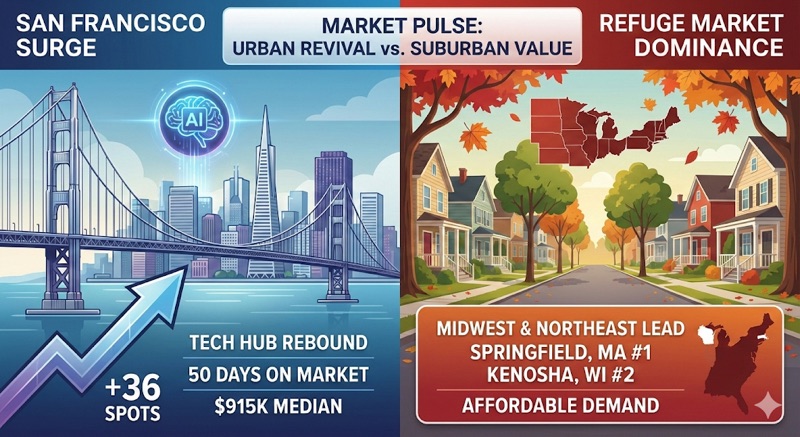
The metro area climbed 36 spots in the Realtor.com Hottest Housing Markets ranking. This is the most dramatic jump among large U.S. markets.
Why this matters to us:
San Francisco is still pricey (median list price: $915k), but it’s becoming efficient again. Homes there are moving in 50 days two weeks faster than the national average.
The Driver: This isn't just random volatility; it’s likely powered by the AI revolution anchoring the local economy.
The Valuation: Prices are actually down 5.6% from last year. As an investor, seeing prices soften while demand velocity increases is a signal that the market is finding a floor. It indicates that while the national market cools, SF is showing resilience.
The Trend: The "Refuge Markets" Are Still dominant
For the 26th month in a row, the Northeast and Midwest were the only regions represented in the top 20 hottest markets.
Leading the pack for the seventh consecutive month is Springfield, MA.
The Logic: It’s all about the spread. Springfield’s median price is $350k. Compare that to Boston, just 90 miles east, where prices are more than double.
The Wisconsin Factor: Wisconsin is currently the heavy hitter of the Midwest, holding 6 of the top 20 spots (led by Kenosha at #2).
The Investor’s Double-Edged Sword:
These "refuge markets" are great for stability, but popularity has a price. Because budget buyers are flocking there from New York, LA, and Chicago, prices in these hot Midwest markets rose 4.5% year-over-year.
My Outlook for 2026
Looking ahead, the data suggests we are moving toward a more balanced national market.
Inventory: I expect the Northeast and Midwest to remain tight on inventory (keeping prices stable), while the South and West will see more softness due to new construction finally catching up.
Rates: If mortgage rates retreat as predicted, we will see a surge of activity in those "middle-ground" markets where affordability is just on the cusp of being reasonable.
The Bottom Line:
The "death of the big city" may have been exaggerated. Smart capital is watching the tech hubs stabilize, while cash-flow investors are still fighting over inventory in the Midwest.
As always, if you have questions about how these macro trends affect your personal portfolio or home equity, just reply to this email.
Best,
Daniel
Quick Stats: November 2025 Top 5 Markets
(Ranked by demand and speed of sale)
Springfield, MA ($350k median price)
Kenosha, WI ($373k median price)
Hartford, CT ($429k median price)
Manchester-Nashua, NH ($560k median price)
Rockford, IL ($249k median price)


Comments
Post a Comment